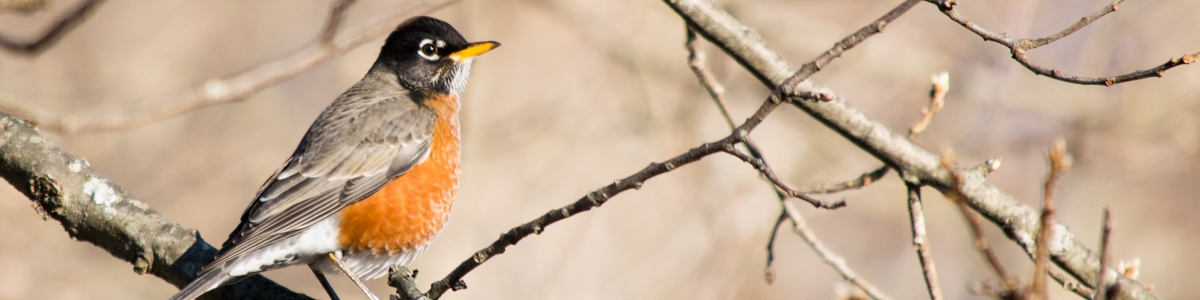
Another sure sign that spring is on the way—at least to someone with my northern sensibilities: a pair of robins has been making regular appearances in our front yard lately. I enjoy watching them sprint up and down the sidewalk from the window as I drink my morning coffee.
Sun /

Just last week the sky was like granite, our breath drifted out as cold clouds, and snow swirled into white streaks across the frozen dirt. Now the sun is back, and the world is blazing with light from the Sandias in the east to the volcanoes in the west. February has given way to March; spring is on the horizon.
Sunflowers /

Here’s another little bit of wonderfulness that I learned from Brett Maverick’s talk at the Gutiérrez-Hubbell House five weeks ago, in his own words:
A good example is this bean field out in Hopi [gesturing to a slide]. This is Karen Reichhardt, she’s also one of the founders of Native Seeds SEARCH, talking to a Hopi farmer. And there’s this wild sunflower growing in the field, and she asked him, oh, what do you do with that? You know, the anthropologist’s point of view, what do you DO with it, do you make a dye, or...?
And he said no... it’s pretty. And the Creator put it here, so why should I take this away?
Yes, alongside all these richly nutritious indigenous heirloom crops that I plan to cultivate out back, so that come harvest I can roast ears of corn, stew pots of beans, fry squash blossoms, slice up fresh melon, puff amaranth seeds for homemade alegría “power bars”—and cook a simple pot of pumpkin soup...
Wild sunflowers that I spotted roadside while driving west into “ZUNI-LAND,” August 2017
I’d also be happy to have some pretty sunflowers.
And of course, we can find a bit to eat within sunflowers, too. Kevin Dahl (also of Native Seeds SEARCH) explains:
Traditional Native farmers roasted and ground sunflower seeds into meal, which they added to soups and stews or baked into cakes or bread. As they do today, children and others enjoyed cracking open the seeds and snacking on the kernels. (Native Harvest: Authentic Southwest Gardening pp 51)
Melon /

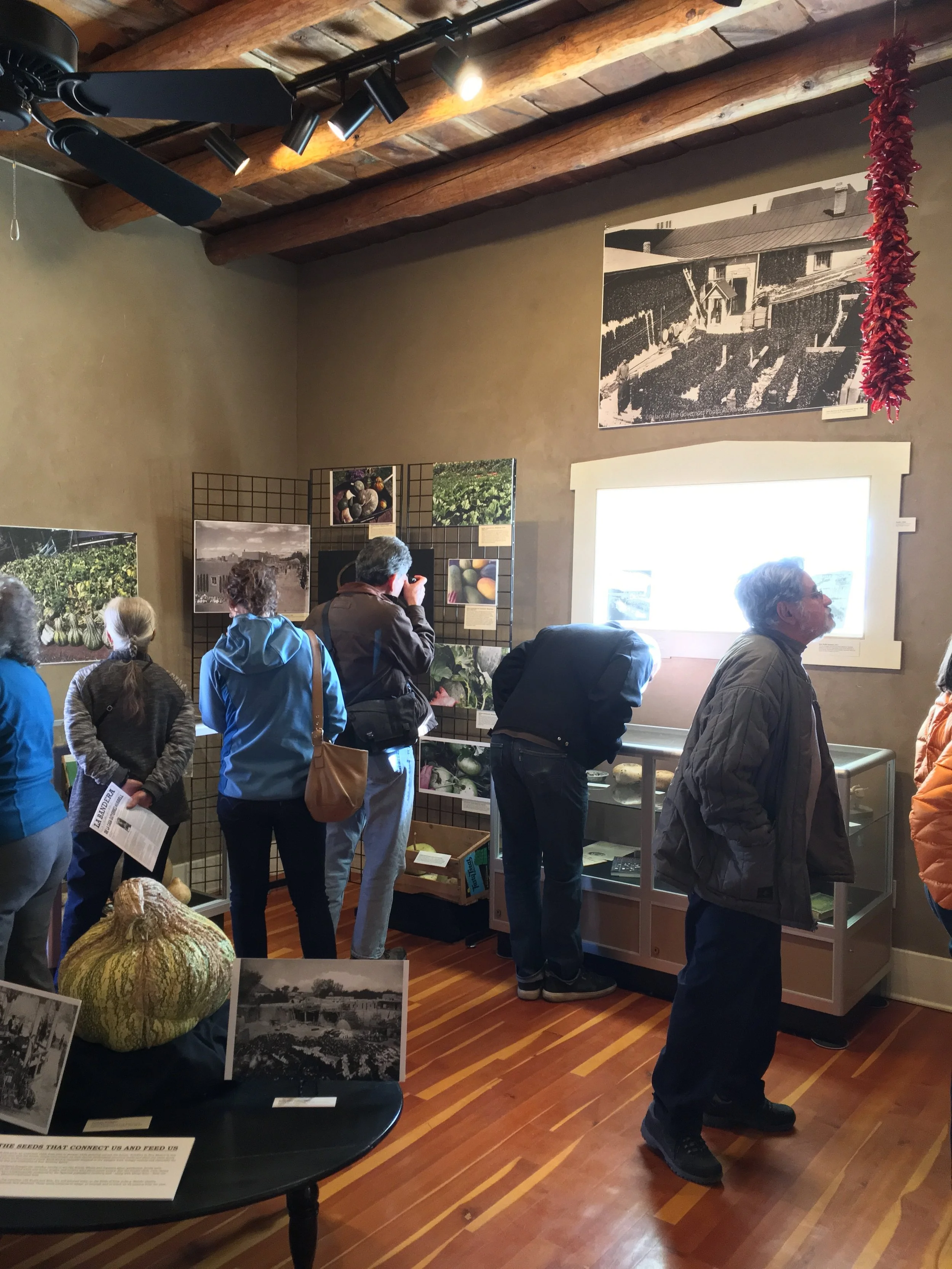
Back in January I had the opportunity to attend a talk by Brett Maverick, who currently serves as Vice-President of the Flowering Tree Permaculture Institute (the community organization founded by Roxanne Swentzell in Santa Clara Pueblo, as you may recall). He had just finished curating a new exhibit at the Gutiérrez-Hubbell House, a historic property in Albuquerque’s South Valley that now serves as a museum space and cultural center.
The exhibit title: The Seeds That Connect Us and Feed Us.
I love that.
And I bring it up today because I also love what I learned from a little panel Brett wrote about melons:
Native watermelons and cantaloupes: Two of the few “native” crops brought to the New World by the Spanish. Sandias or watermelons (Citrullus lanatus) and melones or cantaloupes (Cucumis melo) are native to Africa with additional centers of breeding in ancient Persia (modern day Iran). Spaniards introduced melons to Mexico soon after their arrival. All farmers love to try new crops and by the time the Conquistadores reached New Mexico, melon seeds had already been traded ahead of their arrival, leading the Pueblos to claim melons as one of their native pre-Colonization crops.




Amaranth /
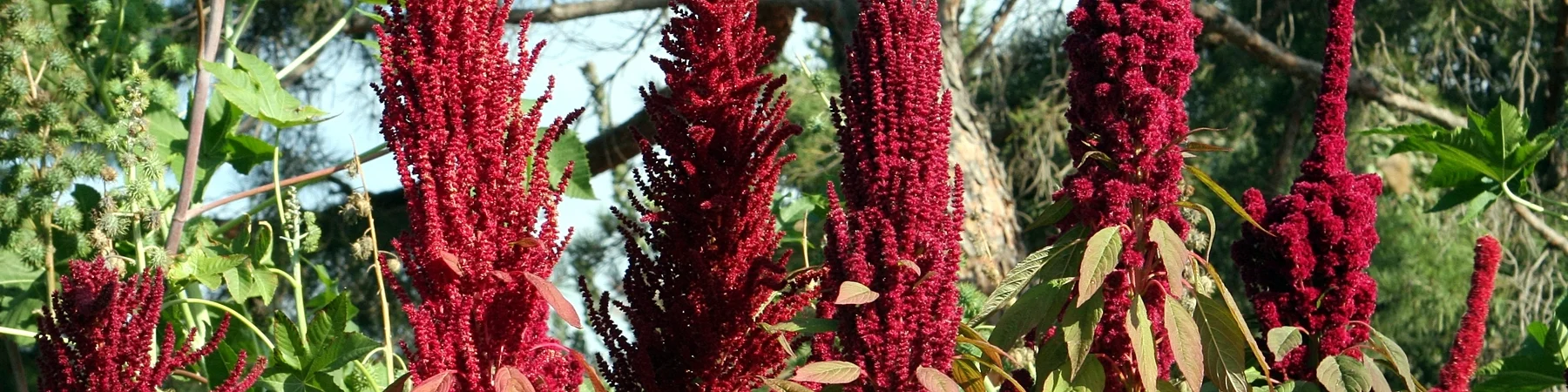
I first heard of amaranth during a two-week visit to Mexico last winter. My friend and I were dashing through a metro station in Mexico City on our way to catch a bus up to Querétaro when she stopped short at a food vendor sitting against the wall of the underground hallway beside a stack of what looked like glossy, speckled bricks. They exchanged a few Spanish words and pesos before we continued our rush to the platform. I forgot the passing moment until we were settled comfortably into the bus and she revealed her purchase to me: a cellophane-wrapped block of pale grains, seemingly puffed and glued together like a rice krispies treat, studded with nuts and berries.

“Here, want some?”
“What is it?”
“Amaranth.”
“Oh. What’s amaranth?”
It turns out she wasn’t sure herself, she just knew it made for delicious street food and an excellent travel snack. When I sampled a corner—mild, sweet, crumbly with a light crunch—I instantly agreed. It wasn’t until later that I’d look it up and learn more about the grain’s origins and significance.
As Kevin Dahl explains on page 26 of Native Harvest: Authentic Southwestern Gardening, “For the Aztecs of Mexico, protein-rich amaranth was a major crop, as important to their economy and rituals as corn.”
In their cookbook Decolonize Your Diet: Plant-Based Mexican-American Recipes for Health and Healing, Luz Calvo and Catriona Rueda Esquibel include a recipe for the specific treat my friend shared with me on that bus trip. Here’s their explanation and ingredient list; you’ll have to get a copy of the cookbook for full instructions!
Alegría Power Bar
We think this is one of the original “power bars.” These amaranth treats date back to before the Conquest, when they were shaped into many forms, including skulls, toys, and mountains. Alegrías are sold today as bars or discs in Mexico City’s tianguis, or open-air markets. The combination of nuts, seeds, and amaranth make this a high-protein breakfast.
3 ½ cups popped amaranth seeds
½ cup raw hulled pumpkin seeds
½ raw hulled sunflower seeds
½ cup chopped peanuts
½ cup dried currants
1 cup raw local honey
¾ tsp sea salt
¼ tsp fresh lemon juice (p 232)

Squash /

To complete the Three Sisters trio, I’ll naturally be planting squash out back as well. But that probably goes without saying at this point; how else would I make my homemade pumpkin soup this fall?
Squash—a category of plant that includes pumpkins—can truly take over your garden during the growing season and your kitchen and pantry at harvest time. A mainstay of southwestern farming traditions, it pays many dividends for the home gardener.
Squash produced two crops, and several types of food, for the Native farmer. Gardeners harvested some of the small, soft-skinned immature fruit to prepare as “summer squash.” They left the rest of the fruit to grow into large “winter squash,” which produces plentiful, sweet flesh. The southwestern varieties have tough rinds and can keep for several months without refrigeration. Some Native farmers stored squash in piles covered with cornstalks, while others kept them in specially constructed storehouses built of arrowweed, willow, and cornstalks. Farmers cut squash into long strips or chips and dried them in the sun like beef jerky. The dried flesh could be stored almost indefinitely. Roasted squash seeds also stored well, though because the seeds made such a delicious snack, they were not likely to last long! Some Native cooks ground squash seeds with other oilseeds, condiments, and fruit to make a sauce, mole pipiáen, which is served today in Mexican cuisine.
The beautiful, large squash flowers are also a delicious vegetable. Gardeners collect male blossoms in particular, which they might fry with other vegetables or add to soups and stews. (Kevin Dahl, Native Harvest: Authentic Southwestern Gardening pp 21-22)

Personally, I’m quite excited about the prospect of harvesting my own squash blossoms. I hear they’re quite a delicacy when fried, but I’ve never tasted them before—only worn them in the form of stylized silver on the occasional borrowed necklace.
Beans /

The second type of seed I plan to plant is also the second of the Three Sisters. While corn pulls nutrients from the soil to grow tall and sweet, beans will replenish it throughout the season by supporting nitrogen-fixing bacteria at their roots. And of course, they’ll make for a delicious source of fiber, protein, and vitamins come harvest. In the words of Sean Sherman, also known as the Sioux Chef:
Dried beans are the backbone of Native cuisine. High in protein, they add body and substance to soups, stews, and salads. When pureed, they become a soft dough for fritters, burgers, and croquettes. (The Sioux Chef’s Indigenous Kitchen p 40)
Corn /

Corn: one of the oldest cultivated crops in the Americas, tallest of the Three Sisters, and the first type of seed that I selected for my garden.
Corn is, and has been for thousands of years, one of the most important foods in the Native American diet. Considered to be the essence of life, corn is sacred to the people. In fact, prayers are offered to corn, as Mother, at many ceremonial dances. The Tewa-speaking Pueblos speak of two corn mothers who were present before the emergence from a former life within this earth: a white corn mother and a blue corn mother. In other Pueblos and tribes, corn may be referred to as Maiden or Sister. The focus is slightly different in each instance, but the ideas of corn as mother, enabler, transformer, and healer are components of the same concept.
Throughout the Southwest, there is a recognition that it is necessary to sing the corn to maturity, to sing to it in order for it to grow healthy and productive. The people ask for blessings from the corn, and ask for the corn to come up strong so that it might feed the people and no one will go hungry.
For Diné [Navajo] people, corn is revered as a food and because it yields pollen, which is important in their healing rituals. For the Diné more than any other peoples, corn is a healer.
For the Tohono O’odham, or “Desert People,” and the Akimiel O’odham, or “Salt River People,” corn is revered and they know it as mother. Again, there were and are songs for all stages of the corn’s growth, as well as for the beans and the squash. (Lois Ellen Frank, Foods of the Southwest Indian Nations p 25)
Seeds /

Okay, back to the seeds. Here’s what I got at last week’s seed swap, as transcribed from various printed and hand-scrawled labels:
- Japonica Striped Maize
- Corn – Sweet / Guarijo Red
- Pole Beans / Fortex
- Bean – Royal Burgundy (Bush – Stringless)
- Cushaw Winter Squash
- NM Indian Squash (Placitas)
- Pumpkin, small sugar
- Halloween Pumpkin
- Watermelon – Hopi Yellow / Bakers Creek Heirloom
- Amaranth (hand-spooned from an open bowl, courtesy of the Garden’s Edge)
- Tomato, Slicing / Costoluto Fiorentino
- Tomatillo De Milpa
- Pepper – Easy / Ancho Gigantea / Capsicum annuum
- Chile Velarde
- Lettuce – Radicchio Rossa di Treviso (Cichorium intybus)
- Carrot – Atlas (Daucus carota)
- Chives, Common
- Helianthus maximiliani / New Mexico Sunflower
Choosing these particular seeds involved a mix of careful forethought and jubilant spontaneity based on what others happened to have arrayed on the library’s tables. Now that they’ve joined me in awaiting the season’s final frost, I can turn my attentions to figuring out precisely where each one will go out there and why.
Snow /
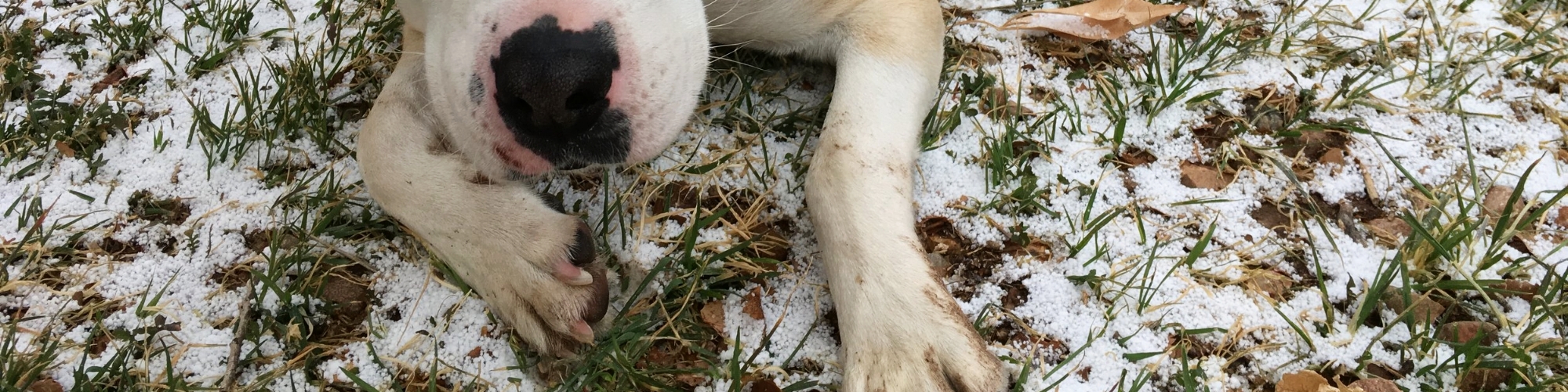
It snowed a few times this past week, for the first time all season. I thought the world should know how much my dog enjoyed it.


