Community, Continued by Karie Luidens

IPCC Resilience Garden.JPG

Starting a garden in my own backyard is an inherently solitary endeavor. Will I find that, as Roxanne Swentzell noted, it’s “hard and lonely to work in a field without others to talk to and work alongside”? If community is so important in committing to a place and a way of life, where should I seek it out? 

Anywhere, of course. I live in the heart of Albuquerque, and there are all sorts of organizations around that would welcome my participation. For starters, I’m signing up to work in the Resilience Garden at the Indian Pueblo Cultural Center, where staff and volunteers cultivate a mix of indigenous and post-contact crops as part of the nonprofit’s mission to educate visitors about Pueblo history and culture. What better way to get involved, give back, collaborate with others, and learn even more about the region’s agricultural heritage as I go? 

Community by Karie Luidens

Flowering Tree.png

What does commitment to a place and its well-being actually look like?

Let’s call it the cultivation of community.

As if in direct answer to Rita Swentzell’s reflections on the unsustainability of constantly wandering the world like tourists, and the need to counter that with a renewed “rootedness in place,” her daughter Roxanne went on to invest in an incredibly rooted existence for herself, her children, and many others around her in Santa Clara Pueblo by founding the Flowering Tree Permaculture Institute in 1987. Its mission: “To nurture healthy communities through practices based on Indigenous ways of knowing. Moving with purposeful care for a sustainable future.”

Over the last thirty years, Flowering Tree has grown into a multigenerational food farm, learning center, and conscientious way of life for dozens of participants. Roxanne describes the significance of the community’s coming together in her recent collaborative publication, The Pueblo Food Experience Cookbook:

People tend to think of farmers as men on tractors, but these farmers [at the Institute] sat on the ground touching the soil inch by inch, noticing life up close while singing songs that came to mind. [...]

After working hard mornings, we would stop for lunch, gathering in the shade of the porch and eating [....] We were tired but grateful for the time together, so much so that many times no one  wanted to leave. [...] Everyone was sad when the season came to an end and the gatherings stopped. We had other jobs and school to attend. 

I can’t help but think that a long time ago, when we were a tighter community, these kinds of gatherings happened every day, year-round, because that is how we survived and enjoyed life. We had to grow our own food because there were no stores. We cooked meals because there were no restaurants. During these times, we visited and saw one another often. We learned how to be respectful and grateful for our food because we knew all the steps it took to get to our tables. 

In these modern times, it is rare to think of manual labor and farming as a good life. We hire someone else to do the work so that we don’t have to. Is this because we have forgotten how to be communal? It is hard and lonely to work in a field without others to talk to and work alongside, so it is understandable that we have divorced ourselves from our food. But on a small part of the earth in the summer of 2014, there was a moment of remembering community and the blessings that come from being connected to one another and our food again. (pp 20-21)

Commitment by Karie Luidens

Commitment.jpg

What was the ultimate harmful hypocrisy of the hippies who washed in and out of New Mexico back in the day? In my assessment, a lack of commitment.

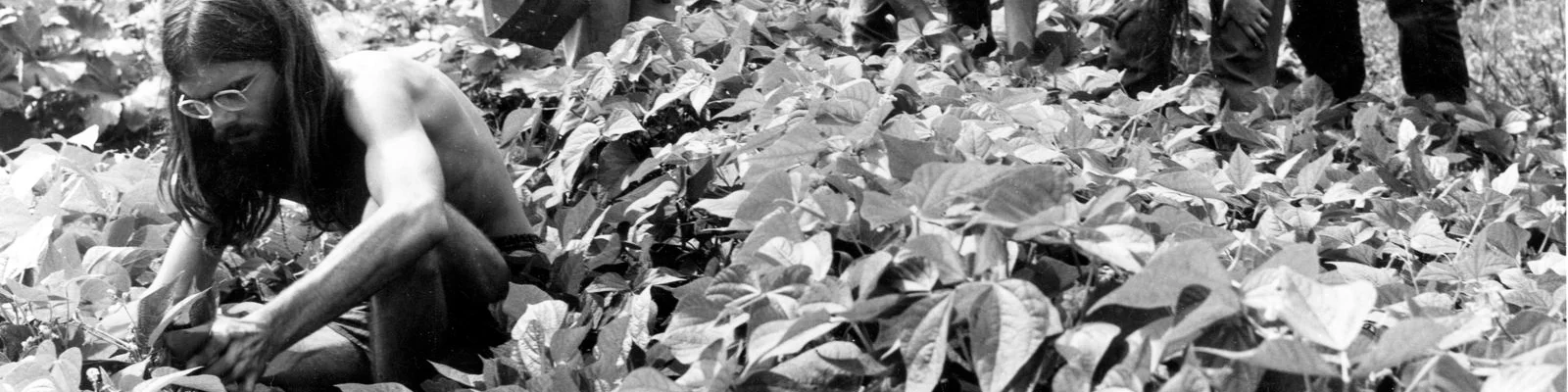
Rebelling against the status quo was easy enough and an attractive fad. Committing to a new way of life was something else entirely, and before long a majority of the West’s counterculturalists burned through the last of their original idealism and enthusiasm. They rolled in when the getting was good, and receded when times got tough—when the novelty of a new place wore off, when drug-induced highs bottomed out, when free love turned costly, when group dynamics grew tense. When all that intensive farming started to seem more menial and difficult than it was worth.

In the absence of a real connection to place—deep roots and relationship—it was all too easy for bands of young drifters to pull up the tepee stakes once more and truck back into town in search of a supermarket.

Rina Swentzell of Santa Clara Pueblo writes of her own semi-nomadic years at the height of hippiedom in her memoir “In the Center and on the Edge at Once.” Here she reflects on some of these dynamics:

Instant communities of the hippies were hard to maintain and sustain because rootedness in place is long term. Sustainability takes intimate knowledge of soil, water, and wind. Life in fast motion and short-term commitment to any place are pure consumption. We were all tourists, in effect. And we do change and affect any environment with our simple presence. Those hippies and other newcomers wanting pure air, direct communication with nature, and simplicity of life helped change that which they desired. Yet we keep moving fast and easy, without commitment to place. (Voices of Counterculture in the Southwest p 151)

So in the spirit of hope that I can transcend the failures of so many of my forebears, both actual and adopted, here’s my commitment.

I’m not originally of this place. And frankly I can’t promise that I’ll put down permanent roots and remain here for the rest of my days.

But I commit to get to know this place and form a meaningful relationship to it.

I commit to being fully present and involved in the well-being of this piece of earth for as long as I am here, stewarding it for whoever comes after me.

I commit to caring for the health of this soil, receiving whatever rains fall and ensuring they aren’t wasted, cultivating ecosystems of worm and seed and microbe in which each creature nourishes the others (myself included), and guarding against the many modernday threats to these interconnected lives.

Hope by Karie Luidens

Hope.jpg

Who are my cultural forebears in this life I’m pursuing far from family and my childhood home? I admit that, as a middle class white newcomer to New Mexico who’s launched a back-to-the-land gardening project, I have some in common with the migrating hippies of yesteryear. At least in their earliest ideals, they were motivated by concerns about unsustainable consumerism and visions of a more meaningful way of life, concerns and visions that I’ve come share.

Now, how can I pursue those original ideals without recreating their movement’s harmful hypocrisies—the ethnocentric sense of entitlement, the invasion of others’ homeland and resources, the disruption and appropriation of others’ cultures? 

The obvious first lesson: Acknowledge the long, rich history of indigenous peoples in this region. Reject old Anglo-American fantasies that the West is a pristine wilderness here for the taking.

From there: Respect the rights and heritage of those who have been here long before I arrived, and approach this place graciously and humbly, as a guest and an apprentice. 

Just as importantly: Know that others’ cultures are sacred to them, and are absolutely not mine to attempt to adopt, especially in the context of this region’s painful legacy of conquests. Remind myself that no matter how eager I may be to learn from everyone I encounter, I have no right to force myself into others’ communities; I am not entitled to practice their ways in part or in whole.

This is my starting point as I set out in search of ancient knowledge and guidance to help my garden thrive. I’m sure I’ll stumble as I go, accidentally offend or overstep my bounds, and continue to adapt.

But I think there’s hope yet that, “hippie heritage” aside, I can do this well. 

Harm by Karie Luidens

Woodstock debris.jpg

Is hypocrisy inevitably harmful? Well, let’s look at what became of the “hippie invasion” of northern New Mexico fifty years ago. Most of the rebellious outsiders who rode the wave into the region looking for a new (old) way to live... ultimately swept back out again within a decade. And in their wake they left a swath of detritus both physical and figurative.

Many hippies eventually gave up trying to live off the land and left. Some were able to sell at a profit properties cheaply purchased from locals, who then watched the prices escalate exponentially with every subsequent turnover. Some went into business and reverted to a middle-class lifestyle mildly inflected with New Age values. Ultimately bohemia was absorbed into hippiedom, which, like every other sector, is discernibly stratified by class. Even today hippies remain a prominent part of Taos’s social landscape. Taos gradually gentrified and attracted new waves of postmodern hippies, affluent amenity migrants, and retirees.

By 1980, most of the communes were gone and the Plaza was a theme mall for tourists. Its old social, commercial, and political functions were now scattered in new constructions along the highway south of town. Real estate prices for old adobes on land with irrigation rights skyrocketed. For every native who emigrated for work or school, two more affluent and educated newcomers arrived. [...] Resentment simmered. In another decade marijuana was still popular but driven increasingly underground. Hallucinogens became hard to find and were slowly replaced by cocaine, heroin, crack, methamphetamine, and prescription drugs. Alcohol consumption remained ever popular, constrained only by an open-container rule on the Plaza. (Sylvia Rodríguez, “Countercultural Taos: A Memoir,” Voices of Counterculture in the Southwest p 114)

The ultimate irony: many if not most of the hippies of the sixties who had hoped to find a pristine place to create a more sustainable lifestyle than consumerism... ended up consuming the region’s resources and then leaving their communes and in-town communities to collapse, unsustained. In a way they perpetuated the very harm they had originally sought to escape or avoid.

Hypocrisy by Karie Luidens

Hippies.jpg

So maybe I’m a little hippie-ish.

But.

After that initial burst of self-recognition in the opening lines of Kopecky’s memoir, I continued to read and found myself recoiling. Pretty soon I had to conclude that he was pursuing a fantasy in his mind’s eye all those years ago, one that blinded him to the reality of the place he was headed. A couple paragraphs later:

From there we set our sights on the warmer Southwest. One day Pepe said, “Load the tipi,” and our little troop, about ten people, headed south to find adventures in the Land of Enchantment. [...] I was soon running deer trails up and down the sides of the valley through piñon and juniper trees, through desert sage and chamisa, in a landscape that could have existed ten thousand years ago. [...] I had traveled from the canyons of New York City to the canyons of New Mexico, where nature reigns in all its beauty.

In his framing, the Southwest offers a sunny playground for adventures, a perfect wilderness seemingly preserved in an Edenic past. Is the land passively awaiting his discovery and ready to serve his needs? Or does it have a long and rich history already? How will the arrival of wandering outsiders affect the local environment and the people who are in fact already at home here, not counterculturalists but practicing their own age-old cultures?

Sylvia Rodríguez offers a different perspective on that era as someone who grew up in northern New Mexico:

The hippie counterculture arose among boomers during the Vietnam War on the heels of the civil rights movement and concurrently with the Black Power, Chicano, and American Indian movements. [...] The early hippies were communitarians. They were environmentalists, primitive back-to-the-landers, drawn to mysticism, supernaturalism, and Oriental religions, longings all abundantly nourished by hallucinogenic or psychedelic drugs. The whole swirling phantasmagoria came with a rock’n’roll/Ravi Shankar soundtrack.

The Great Taos Hippie Invasion started in the summer of 1967 and went on for about four years. [...] Thousands of mostly white, mostly middle-class, young people began to pour into northern New Mexico, fleeing the corruption of cities and suburbs in search of a pristine altiplano utopia replete with Indians, earthen architecture, and the promise of spiritual awakening. Taoseños reacted to the sudden influx more or less according to socioeconomic position and age. Hippie displays of excess, transgression, and abandon shocked and threatened businessmen like my father. [...] Proper middle-class Hispanos willing to tolerate a few beatniks were aghast at the spectacle of hippie dress, drug abuse, loose morals, poor hygiene, sin verguenza (shameless) violation of sexual norms, and flagrant use of food stamps and free clinics. (“Countercultural Taos: A Memoir,” Voices of Counterculture in the Southwest pp 110-111)

There’s a word we’ve heard before about this place: “invasion.” A “hippie invasion.”

Did these hippies consider that by descending on the West in droves, they were encroaching on others’ lands and waters—even as they criticized their government for its own encroachment on lands and waters around the globe? Did they find it ironic that they idolized the concept of pristine places, then “polluted” them with their very presence, rumbling in on diesel buses armed with foreign drugs and disruptive behavior? Surely some of them must have recognized that their communes were superficially fetishizing indigenous cultures by setting up tepees and taking peyote, whether or not they had any sense of such practices’ context or significance.

Yes, I can recognize a bit of myself in the hippies of fifty years ago: as Rodríguez put it, I’m white, middle-class, and young. I’m an outsider who’s rejecting some elements of the mainstream and attempting to act more or less like a back-to-the-lander in my backyard. 

But I hope it’s possible to pursue a “countercultural” life here without all these harmful hippie hypocrisies.

Hippie by Karie Luidens

Hippies Farming.jpg

Now that I’ve ended up moving south to New Mexico, I hope to honor this place and the people who have been here for thousands of years by humbly learning how they’ve lived in harmony with the natural world and cultivated crops to nourish themselves. They know this land, its climate, its species, and its interrelationships; they know how to lead the sort of healthy, sustainable life here that I’m seeking to lead myself.

At the same time, I recognize that I am emphatically not an heir to the region’s ancient cultures. I was raised elsewhere with a radically different worldview. I’ve only recently relocated here, and more recently still begun to learn about this place’s rich and complicated history, including its agricultural traditions. 

Given my status as a newcomer, not to mention my rather naive “back-to-the-land” project, I think it’s fair to say that the cultural forebears I’ve ended up emulating these days are twentieth-century hippies. 

Ah, the hippies...

While the housewives of Betty Friedan’s studies were suffering from a “problem with no name” in the 1950s, by the end of the 1960s counterculturalists had plenty of names for society’s problems: consumerism, capitalism, industrialism, militarism. Hippies renounced the flashy lifestyle that the era’s Mad Men were selling, left behind suburban America’s cookie cutter houses and gleaming appliances, and hit the road in search of a fresh start. Their mission: a life not of mindless consumption but of substance and meaning. Authenticity. Community. Sustainability. Within a few short years of their westward migration, communes had sprouted up across the mountains and deserts from here to the Pacific. 

Reading the first-hand accounts of those who took part in this great hippie wave, I sometimes feel a deep sense of self-recognition. Take Art Kopecky’s introduction to his memoir about living in a commune outside Taos in the 1970s:

Once when I was about twenty years old, I was in midtown Manhattan about 5 p.m., surrounded by a gigantic flood of people as the office towers disgorged their occupants. “How precarious is our civilization, how precarious these people’s lives,” I thought. They get everything they need with money, and if that money stops flowing into their account, they are almost immediately desperate, truly desperate. Our society is almost hysterically, continually trying to grow when it is already too big, to keep the money flowing, finding something for all the people to do.

These thoughts, among other things, propelled me to step onto and into the near pristine, wide-open spaces of northern New Mexico. (“A New Buffalo Vision,” Voices of Counterculture in the Southwest p 95)

Yes, I can relate to this sentiment about modern society’s superficiality and unsustainability, as well as this motivation to rediscover a simpler, stabler way of living. In this sense, at least, I can accept that I’ve become a bit of a hippie myself.

Hopi by Karie Luidens

Hopi.jpg

Books will never come close to the sort of learning I anticipate getting from hands-on experience, both working in my own patch of land as well as talking with more experienced gardeners, visiting their farms, attending more workshops like last month’s vermiculture presentation, participating in seed swaps, and so forth.

But… I’m still a book nerd at heart, so I’ve already gathered a stack of titles on the subject of agriculture in the region. Most recently I finished Kevin Dahl’s Native Harvest: Authentic Southwestern Gardening, which focuses a little less on my particular locale in New Mexico than on the peoples of Arizona like the Hopi, but offers this sweeping overview of the whole Southwest in its opening chapter:

In this arid country, Native farmers developed a number of water-wise ways to ensure a successful harvest. Along the major rivers in central Arizona, canals and irrigation ditches brought water to the fields after spring snowmelt raised the river level, ushering in the first warm-weather crop. Later, during the summer rains, the canals and ditches brought a second growing season to the people living in places such as Central Arizona. Elsewhere in the Sonoran Desert, farmers planted fields at the mouths of foothill washes so that seasonal water flows could irrigate their plots. Zuni farmers grew plants close to their village in gardens that were sculpted with waffle-like indentations, making it easier to water the plants with pitchers of creek water. Most Hopi corn fields look like sand dunes. Beneath the sandy topsoil, layers of clay soil retain snowmelt that nourishes plants during the summer growing season.

Songs, ceremonies, and hard work accompanied all aspects of Native farming. Trading seeds and stories, farmers adapted plants over time to help them feed their families under a variety of conditions. They also cultivated crops for use as containers, rattles, and utensils (gourds), basket-making material (devil’s claws), and fiber (cotton), as well as cooking and medicinal herbs.

Fortunately, traditional southwestern gardening is a living heritage. Though not nearly as widespread as they once were, gardens planted by American Indian farmers are tended and harvested annually. O’odham farmers grow huuñ (a short corn that fully matures in 60 days) and bav (protein-rich tepary beans) using the summer thunderstorm runoff that reaches their fields in southwestern Arizona. Hopi farmers tend their spring-fed garden terraces below the high mesas where they live in northern Arizona. Like their ancesotrs centuries ago, Santa Clara Pueblo farmers in present-day New Mexico clear out irrigation ditches so that Río Grande water can support fields of corn. The sprawling Navajo nation—the largest Indian land in our country—has both commercial tribal farms and small plots tended by individual families. (pp 5-6)

History by Karie Luidens

Cultural Education staff forms adobe waffle beds in the Indian Pueblo Cultural Center’s Resilience Garden, April 2017

Cultural Education staff forms adobe waffle beds in the Indian Pueblo Cultural Center’s Resilience Garden, April 2017

Let’s see: my backyard’s garden area has now been cleaned up, tilled, and demarcated; I’ve got a vermiculture bin and a compost heap going in hopes of helping the soil grow ever healthier as time passes. The weather has been unseasonably warm as I’ve worked outdoors these last couple of weeks, but the ground still gets frosty at night, so it’ll be at least another month before I plant anything.

Which is great, because I’ve still got so much to learn about how to care for these future crops.

Especially given that I’m making my first foray into “farming” here in the arid Southwest. From the coarse plains east of Albuquerque, to the forested mountain slopes up around Taos, across scrubby desert to the western mesas of Acoma and the Hopi, the region’s topography is incredibly diverse. But in the eyes of an outsider like me—someone who grew up in a comparatively lush northern climate, and who associates agriculture with endless, dense green fields soaking up several rains a week—it all shares at least one trait: it all strikes me as pretty inhospitable to cultivating plant life.

That perception only reveals my ignorance as an outsider. Over the course of a history going back thousands of years, the people of this place have developed a deep understanding of the vibrant relationships between sandy soils, snowmelt, prevailing winds, mesa-top pools, runoff in the rainy season, riverbeds’ ebbs and flows, and the many different seeds that can thrive when cultivated in these conditions.

That is to say, thanks to the region’s rich agricultural tradition, I’ll be able to draw on centuries of well-established knowledge and techniques as I learn how to tend my garden. I’m just starting to scratch the surface of all this historical wisdom, but I’m excited to delve deeper in the months ahead.

Fences by Karie Luidens

Fences.jpg

Although on principle I’m not a fan of cutting up land with artificial boundaries, before I plant seeds this spring there’s an obvious need to keep my dog out of the garden. It’s time to figure out what sort of fencing makes sense here.

While I work out the dull details of material and installation, here’s a more meaningful meditation on the subject of fences, courtesy of Chumash cultural educator Tima Lotah Link:

So the Spanish came, and then the United States, and they swept over the land, and when they were done it was cut into tiny little pieces and they put fences around those pieces. We live in a world of fences today. And those fences are boundaries between us and the landscape. I respect boundaries, I think we all do in this world today, but fences—borders—dams—some things were never meant to be.

(On the other hand, dog poop was never meant to be in my food garden...) 

Journey further with Tima as she explains her relationship to the land and fences in episode 3 of KCET’s program “Tending the Wild.”