The rich, fertile “castings” my new worm herd promises to produce in the weeks ahead: excellent.
My dog pooping in the recently dug-up garden area this morning: not great.

The rich, fertile “castings” my new worm herd promises to produce in the weeks ahead: excellent.
My dog pooping in the recently dug-up garden area this morning: not great.
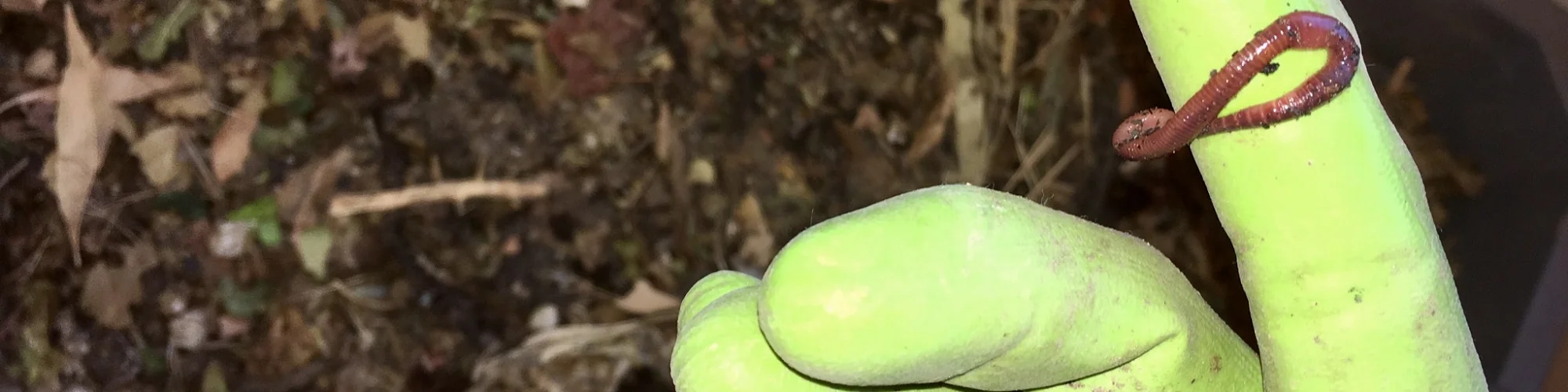
Okay, fine, I guess the worms are kind of cute. Look at that little red wiggler go on my glove!

My worms are here! One pound of red wigglers, which I’m told should be about a thousand of them. I’m also told I will grow to love them like little pets. At present they just give me the willies.
I mean, look at them.
Ew.
But apparently they’ll munch their way through my kitchen scraps and churn out “black gold” for my garden beds, so, okay. I’ve set up a little nest for them and commited to giving them a lifetime of tender loving care.

All that raking, cleaning, and digging—I feel it in my shoulders, sore twinges every time I lift a glass of water to my lips. It feels a little like pain, but mostly like accomplishment.

The ground has been cleared of debris, both leafy and manmade. Next step: another week’s worth of yardwork to loosen its dusty, hard-packed crust so it can welcome the compost to come. (Digging.)

Also unearthed and stacked alongside the new leaf heaps: a dozen or so old paving stones, several cinder blocks, some crumbling bricks, four crusty dog toys, two glass bottles, and a pile of rusted bottle caps. If the ground can now breathe again, maybe its first exhale was a sigh of relief.

My first hands-on accomplishment in the yard: a full morning spent raking up several seasons’ worth of leaves, which were heavy and matted across the sparse grass. They’re now gathered into three heaping mounds, and the ground can breathe.

I recently attended a vermiculture workshop led by Master Composter (!) Mel Chavez of Bio Worm Farms here in Albuquerque. Throughout, I scribbled notes to prepare for raising worms myself, including this quote:
“Worms each have five hearts—there’s a lot of love in there.”
❤❤❤❤❤

In making amends, we transform dirt into soil.
Per Rebecca Louie in her book Compost City:
When you feed and nurture the soil, you feed and nurture everything that depends on that soil to survive—which includes you.
Soil is an elegant ecosystem made up of organic matter (called humus), rocks, minerals, water, air, and a web of micro- and macroorganisms. It’s not to be confused with dirt, which is the stray stuff stuck in your sneaker treads or smeared across your jeans. Soil is rich with life, and we hold it close to our gardens and our hearts. (pp 4-5)
So—from now on, no more talk here of “dead dirt.” Instead, “soil.”

According to my recent research, the first step in healing abused and neglected land and cultivating its potential for life will be to “amend the soil.”
A few weeks ago this phrase was new to me, but I’ve read enough now to understand that it means tending to the dirt, fostering the right consistency and nutrients to support everything from microbes to new roots.
“Amend?” my partner asked when I started explaining what I’d learned. “Like, the First Amendment?”
“I think more like, making amends.”