Options by Karie Luidens

Options.jpg

Native, invasive. Sacredness, secularization, desecration. It would be easy for me to ignore all these apparent abstractions. More than easy. The now-established culture wants me to ignore them and continue consuming whatever it’s selling, “consume” figuratively or literally in the form of foodstuff. I could shrug off all this information, figure what’s done is done, accept the current state of things, and continue to purchase packaged goods and fast food like millions of others across the continent. 

But assuming I don’t want to ignore all this—assuming I want to acknowledge the world’s ugly history and the ways humans have wreaked havoc on lands and peoples for profit—assuming I want to conscientiously lead a life that helps heal the land and the people rather than perpetuate harm—what are my options?

I could renounce this land that doesn’t belong to me, and leave.

I could reclaim my true ethnic heritage and try to forge an old-fashioned sustainable Dutch livelihood… somewhere…

I could try to do right by this small patch of backyard that’s currently in my stewardship. I could acknowledge that I’m wrong to think of this dirt as dead, and instead see its potential for sacred relationships to all life—including my life. I could take a deep, cleansing breath and sink my hands and tools into caring for it anew.

Desecrated by Karie Luidens

Desecrated.jpg

No, secularization seems like too soft a term. The opposite of “sacred” isn’t just “secular,” it’s “desecrated.” 

Here’s a sample of what the United States has done in this region in the 160 years since it declared war on Mexico, launched a military invasion, and used the 1948 Treaty of Guadalupe Hidalgo to acquire 525,000 square miles of western territory (the present-day state of New Mexico as well as Arizona, Nevada, California, Colorado, Utah, and Wyoming):

Funny, the Treaty of Guadalupe Hidalgo was officially titled the “Treaty of Peace, Friendship, Limits and Settlement between the United States of America and the Mexican Republic.” From a ground war, to peace and friendship, to developing the atomic bomb here in no time flat. Sometimes we seek the exact precise word for a situation, and other times we throw words around like they mean nothing at all. 

Secular by Karie Luidens

Secular.jpg

Recent peaceful marches and past violent marches couldn’t seem more different, but they do share one common trait: marches indicate cultural change. For better or for worse. Who knows what lies ahead for us all.

As for what’s already come to pass, I think Jack Loeffler captures the cultural effect of my country’s westward invasion in Voices of Counterculture in the Southwest: what the United States has ultimately imposed wherever it’s expanded is

a culture where success was measured in terms of money, where consumerism was a reason to be, a culture now the militarily mightiest in the world, a culture driven to secularize habitat and turn it into money by mining its minerals, developing the land with little or no regard for the landscape or its denizens. (pp 19-20)

“A culture driven to secularize habitat.” Yes: precisely. If the opposite of “native” is “invasive,” wouldn’t the opposite of “sacred” be “secular”? The United States is indeed an invasive species here in the West, and the “economic or environmental harm” it has caused—submitting healthy homeland and farmland and hunting grounds and wilderness to brute, polluting resource extraction and cheap sites for commerce—could be summed up as the secularization of sacred land. 

Sacred by Karie Luidens

Sacred.jpeg

Marching north, marching west, invading each others’ sacred lands... This is humanity’s long shared history. But today millions of us will march together, not in conquest or battle but in solidarity.

In a few hours I’ll be joining the 2018 Women’s March here in Albuquerque, accompanied by the homemade sign I drew up yesterday afternoon. Given the endless list of issues at stake in politics today—racist rhetoric, xenophobic policies, threats to health care and education and environmental protections and the free press and democratic institutions and international relations and more—the idea of choosing a single issue for this superficial shout-out seemed impossible. My conclusion was simply to create a sign that reflects my most basic values. 

I guess, to rephrase “sign with values,” I’m “virtue signalling.” Hmm. 

Still, better to signal virtue than not to signal virtue, I hope. It’s at least a start, or a step in the right direction. I look forward to taking that step and many more with a whole crowd of compatriots in this peaceful march of progress. 

Invasive, Continued by Karie Luidens

Invasive 2.JPG

Sometimes I feel I’m a member of an invasive species here in the West, or el norte, or Tiguex, or whatever you want to call this place based on your people’s language and history of migration.

My ancestors had no connection to this land. They farmed in the Netherlands, then shifted to Michigan in the late 1800s: marshy lowlands near oceans and Great Lakes, not high deserts. I’m only able to live here—to casually load up my sedan and drive into town and rent a house and get a New Mexico driver’s license—thanks to a series of invasions over the last five centuries. First Spanish conquistadors marched north from Mexico in the 1500s and 1600s, then the United States Army marched west from the Mississippi in the 1840s.

Waves of foreign conquering forces obliterated this region’s existing balances, imposed new economic and political systems, and forced new languages and practices upon evolving populations. With Route 66 and eventually the interstates, my government literally paved the way for me to roll in.

Invasive by Karie Luidens

Invasive.png

Plants, animals, people—we all originated somewhere. We’re all “native” to someplace. So to say that a species is “native” is only meaningful in contrast to… something else. 

An invasive species. 

Although I think I could craft a definition of “invasive species” based on my own understanding, lately I’ve been trying to check myself by looking up old knowledge I may have come to take for granted. Here’s what I found, courtesy of the United States Department of Agriculture:  

As per Executive Order 13112 an "invasive species" is defined as a species that is:

     1) non-native (or alien) to the ecosystem under consideration and
     2) whose introduction causes or is likely to cause economic or environmental harm or harm to human health.

Invasive species can be plants, animals, and other organisms (e.g., microbes). Human actions are the primary means of invasive species introductions.

It strikes me as ironic that this official definition was issued by a government that is itself so inherently invasive, from its coastal inception to its westward expansion to its imperialistic growth around the globe. Yes, “human actions are the primary means of invasive species introductions.” The first step is generally to be an invasive species ourselves: invading others’ homelands, interrupting harmonious ecosystems, destroying communities’ age-old self-sufficiency, undermining what’s sacred. 

Native by Karie Luidens

Corn growing at the Sky City Cultural Center & Haak'u Museum in the Pueblo of Acoma, August 2016

Corn growing at the Sky City Cultural Center & Haak'u Museum in the Pueblo of Acoma, August 2016

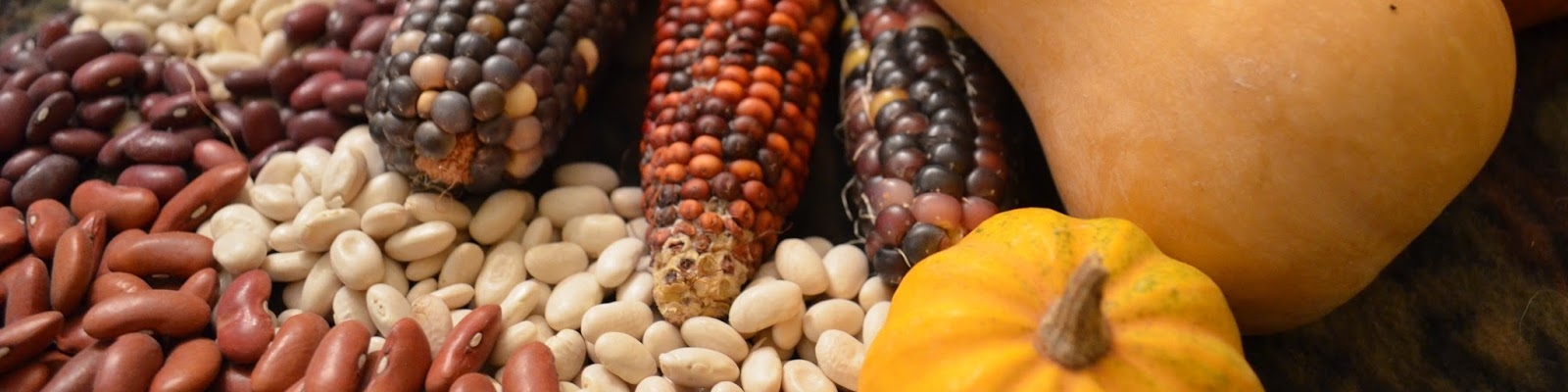
The Three Sisters are a natural choice as I plan and plant this food garden because they’re native to the region. They are of this place; people have cultivated them in this climate for centuries, and they’ve thrived in spite of desert droughts and frigid winters and dirt that seems dead. Year by year by year, corn, beans, and squash developed an ancient and profound relationship with this sweep of earth and sky. Some say it’s a relationship that goes beyond mere evolutionary adaptation. 

See, for instance, Lois Ellen Frank’s introduction to Foods of the Southwest Indian Nations, which opens with these words:

Native Americans have lived on this land since before history’s written records, far beyond any living memory. The story of the people in the Southwest and the story of this place is one story. One cannot think of this place and not think of its people. Indigenous people of the Southwest are as diverse as the land they live on. Nevertheless, they share the belief that food is important beyond physical sustenance. The acts of hunting, growing, gathering, cooking, and eating take on a spiritual aspect akin to prayer. The relationship between the land and its people is sacred.

There it is again: sacred. Sacred.

Three Again by Karie Luidens

Three Sisters.jpg

Back to the number three. I’ve been weighing what seeds I’ll plant once I’ve amended the soil out back, and the first and most natural choice for a food garden in this region of the world is the Three Sisters.

Melissa Kruse-Peeples of the nonprofit Native Seeds/SEARCH explains:

For many Native American communities, three seeds - corn, beans, and squash represent the most important crops. When planted together, the Three Sisters, work together to help one another thrive and survive. Utilizing the corn, beans, and squash together in your garden draws upon centuries of Native American agricultural traditions and expertise.

Corn provides tall stalks for the beans to climb so that they are not out-competed by sprawling squash vines. Beans provide nitrogen to fertilize the soil while also stabilizing the tall corn during heavy winds. Beans are nitrogen-fixers meaning they host rhizobia on their roots that can take nitrogen, a much needed plant nutrient, from the air and convert it into forms that can be absorbed by plant roots. The large leaves of squash plants shade the ground which helps retain soil moisture and prevent weeds.

Anyone who wishes can learn more, along with me, thanks to Native Seeds/SEARCH.

Four by Karie Luidens

Four (Zia Pottery).jpg

Of course, different cultural traditions hold different numbers to be sacred. Four, for instance.

Four seasons: winter, spring, summer, fall.
Four ages: infancy, youth, adulthood, old age.
Four cardinal directions: north, south, east, west.
Four phases of each day: dawn, daylight, dusk, darkness.

Since different traditions disagree, I suppose I’m not sure what’s actually sacred in life. I suppose that’s what I’m searching for. And if all our cultural traditions have branched over the ages from some ancient common heritage as a single human race, I suppose my instinct is to trace them back to their oldest and deepest shared root: survival. Sustenance. Dirt. 

Three by Karie Luidens

Three.jpeg

My body can survive three minutes without oxygen, three days without water, three weeks without food. That’s what I was told once, and I hope never to test the theory. 

Three is a sacred number according to the tradition in which I was raised. I can still hear the hymn’s lyrics as sung to the resonating organ and echoing off stained glass on Sunday mornings: 

Holy, holy, holy! Lord God Almighty! 
Early in the morning our song shall rise to Thee
Holy, holy, holy, merciful and mighty! 
God in three Persons, blessed Trinity!

Oxygen, water, food; my body’s blessed trinity?